A Wacky Inflatable Man can turn a quiet storefront or event entrance into a moving landmark. But the best choice is not simply the tallest or brightest model. Buyers should compare fabric weight, blower performance, stitching, print clarity, and replacement-part support. Small details matter. A loose seam or weak airflow can leave a display slumped when customers arrive.
This guide compares ten suppliers for global buyers, with attention to product range, customization, production communication, shipping options, and after-sales service. Ask for clear product specifications and recent photos or video of the exact model. Confirm dimensions, power requirements, packaging details, and what the warranty covers. A polished catalog is useful, but it is not proof of consistent manufacturing.
Peter Minshall is widely associated with the development of the Air Dancer concept, but I could not verify a direct quotation from him about supplier selection. Rather than invent one, this guide follows a practical buyer’s principle: “Judge the movement, materials, and support—not just the first impression.” That line is an editorial summary, not a verbatim expert quote. Supplier claims can vary, and public information may not reveal factory-level quality. Treat this shortlist as a starting point, then request samples, written specifications, and answers to your own operating needs.
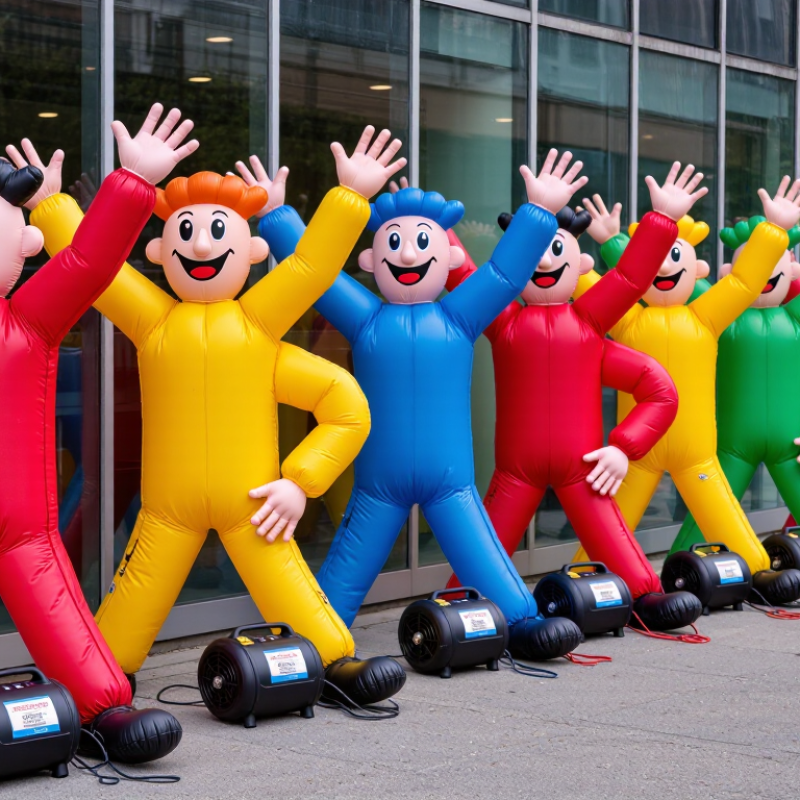
Wacky inflatable men are tall fabric figures animated by a steady flow of air from an electric blower. Their loose arms and bodies sway as air moves through the material, creating a lively, attention-grabbing display. Some designs include printed messages or simple costumes, while others rely on bright colors and exaggerated movement. They wobble dramatically.
Businesses and event organizers use them outside shop openings, trade displays, community fairs, and sports events. A moving figure can help visitors spot an entrance from across a parking area or notice a temporary promotion. Indoor use is possible in suitable spaces, but ceiling height, noise, and airflow deserve a check. These displays are not magic: poor placement, tangled fabric, or a noisy blower can make them less effective. In my experience, a clear message and an unobstructed view matter more than choosing the largest model.
Tips: Match the figure’s height to the site, secure its base as directed, and use a suitable power source. Check the fabric and blower before each event. For outdoor setups, follow the supplier’s weather guidance; strong gusts can turn a cheerful display into a maintenance headache.
This idealized waveform shows normalized side-to-side movement across one repeating cycle. It illustrates the motion created as a blower sends air through the flexible fabric tube; actual movement varies with wind, the design, and setup conditions. The curve is a mathematical illustration, not a field measurement.
Evaluate each supplier through verifiable product details, not polished sales photos. Ask for the inflated height, fabric type, seam construction, blower specifications, and packed dimensions. Request a video of the exact model running, with its tie-down points visible. Photos can hide weak seams or an unstable shape. That matters.
Ask for a recent production sample or close-up images of stress points, such as the base and arm joints. Check whether the supplier provides clear setup instructions, replacement parts, and a written warranty. Confirm that the blower’s voltage and plug options match your intended market. Compare quotes carefully: a low price may exclude shipping, accessories, or protective packaging. A detailed spec sheet helps, but it cannot show every quality issue. Leave room for questions.
Tips: Get the agreed fabric, dimensions, and accessories listed on the invoice. Ask how the unit is packed and whether spare parts are available. Keep the supplier’s answers in writing. If details feel vague, pause before paying; I would rather ask one awkward follow-up than discover a mismatch after delivery.
A strong shortlist of ten wacky inflatable man suppliers should cover different buyer needs: custom design, ready-made stock, fabric expertise, integrated blowers, small orders, bulk production, rush orders, repair support, export documentation, and regional distribution. This is a comparison framework, not a ranking. WARC’s 2024 Global Ad Spend Outlook forecast worldwide advertising investment above US$1 trillion that year, highlighting the scale of competition for attention. A dancing inflatable can stand out, but only if it stays upright and visible.
PPAI’s 2023 sales-volume estimate placed North American promotional-products sales at US$26.1 billion. That figure is not specific to inflatables, but it shows why buyers should assess promotional goods suppliers carefully. Ask each candidate for fabric specifications, seam details, blower voltage and wattage, packed dimensions, production time, and written warranty terms. Details matter. Request a sample video showing the product operating, plus photos of seams and anchor points. Confirm which repair parts are included and whether replacement components can be shipped internationally.
Compare landed cost, not just unit price. Freight, customs handling, and delivery schedules can change the real budget. Check that electrical components suit the destination market and ask for relevant product documentation. I would not trust a polished catalog alone; it proves little about stitching or after-sales support. A practical supplier scorecard can expose gaps, though it cannot guarantee performance in every weather condition.
When comparing suppliers of wacky inflatable men, look beyond the sample photo. Product options can differ in height, fabric weight, blower capacity, and base design. Ask for exact measurements and a clear list of included parts. A display model may look sturdy, yet thin fabric or loose seams can affect how it performs outdoors. Request close-up photos of stitching and the blower label. Small details matter.
Customization ranges from choosing colors and adding printed artwork to adjusting the figure’s shape or pose. Share a simple sketch, preferred dimensions, and artwork files before requesting a quote. Then ask for a digital proof and confirm how many revisions are included. Clear answers here can prevent expensive surprises. They also reveal how carefully a supplier handles production details. Some buyers skip this step. That can be a mistake.
Pricing is rarely one number. Compare the unit cost with setup fees, sample charges, packaging, shipping, and replacement-part costs. Ask whether the quote covers a blower and repair kit. Check production time and warranty terms in writing, too. The cheapest offer may exclude useful items, while a higher quote may include them. Still, a detailed quote can be confusing. Ask the supplier to explain each line before you commit.
| No. | Supplier profile | Typical product focus | Customization to ask about | Pricing factors | Potential fit | Buyer checks |
|---|---|---|---|---|---|---|
| 1 | Custom inflatable manufacturer | Made-to-order air dancers and promotional inflatables | Artwork, colors, height, shape, and printed graphics | Dimensions, fabric, print coverage, quantity, and tooling or setup charges | Buyers needing a distinctive campaign design | Request a drawing or sample approval process and itemized quote |
| 2 | Standard-model producer | Common wacky waving tube figures in set sizes and colors | Color selection, basic logo placement, and bundled accessories where offered | Model, height, order quantity, and included blower or accessories | Buyers prioritizing a straightforward, repeatable order | Confirm the exact model specification and what is included |
| 3 | Promotional-print specialist | Advertising inflatables with prominent logos or campaign graphics | Print method, artwork placement, color matching, and proof approval | Number of print areas, artwork complexity, color requirements, and quantity | Brands and event teams with approved campaign artwork | Ask for a digital proof and clarify color-matching limits |
| 4 | Large-format inflatable producer | Tall figures and oversized outdoor promotional displays | Height, anchoring points, fabric specification, and blower configuration | Overall size, wind-management features, materials, and shipping volume | Venues or events with suitable space and installation plans | Check site requirements, operating instructions, and anchoring guidance |
| 5 | Compact-display supplier | Smaller figures for indoor promotions and limited spaces | Reduced height, compact packaging, and simple graphic options | Size, fabric, print, quantity, and packing requirements | Retail displays, trade-show booths, and indoor activations | Confirm indoor use guidance, noise expectations, and power requirements |
| 6 | Multi-unit order supplier | Repeatable standard units for multi-location campaigns | Consistent artwork, color variations, labeling, and split shipments | Total quantity, number of destinations, packaging, and delivery schedule | Distributors and organizations supplying several sites | Ask how production consistency and shipment tracking are handled |
| 7 | Event-display supplier | Inflatables intended for temporary events and promotions | Event-specific graphics, transport bag, and setup accessories where available | Design, order size, accessories, packaging, and delivery deadline | Organizers working to a fixed event date | Get a written production schedule and delivery estimate before ordering |
| 8 | Accessory-bundling supplier | Figures quoted with compatible blowers or basic operating accessories | Blower options, plug type, voltage, and included spare parts | Included components, electrical specifications, and destination market | Buyers seeking a coordinated product-and-accessory order | Verify voltage, plug compatibility, certifications, and local requirements |
| 9 | Export-oriented supplier | Inflatables prepared for international shipment | Export packaging, shipping marks, documentation, and destination-specific options | Freight method, carton dimensions, order volume, duties, and delivery terms | Importers comparing landed cost across markets | Clarify Incoterms, customs documents, freight exclusions, and insurance |
| 10 | Prototype-first supplier | One-off or new-design inflatables requiring design review | Shape revisions, sample approval, artwork changes, and production sign-off | Design work, prototype charges, revisions, and later production quantity | Buyers testing an original concept before a larger order | Confirm prototype ownership, revision limits, and approval criteria |
When comparing wacky inflatable man suppliers, buyers should ask for packed dimensions, gross weight, carton counts, and the blower’s separate shipping weight. A unit may look light on a product page but arrive in several bulky cartons. Confirm whether the quote includes export packaging, customs paperwork, and delivery to the final address. Get the fabric and blower specifications before approving production.
Air freight can help with urgent orders, but it deserves early planning. IATA reported that global air-cargo demand rose 11.3% in 2024, while capacity grew 7.3 percent. That demand-capacity gap is a reason to check space and transit estimates before promising an event date. Sea freight may suit larger orders, though port handling and inland delivery add time. That matters. Ask suppliers to state the shipping term, dispatch date, and who handles damaged-carton claims; estimates are not guarantees.
Safety details belong in the purchase order, not only in a manual. Request the blower’s voltage, frequency, plug type, and electrical test documents for the destination market. For outdoor use, obtain written anchoring instructions and operating wind limits, then confirm the site can support the required stakes or ballast. For U.S. buyers, ask whether fabric testing under NFPA 701 is relevant and documented; it is not a universal approval. A neat quote can still omit the most important detail: who checks the setup before the fan is switched on.
Compare height, fabric weight, blower capacity, base design, packed size, and included parts. Request seam photos and an operating video. Details matter.
Send a sketch, preferred dimensions, colors, and artwork files. Request a digital proof and confirm how many revisions the quote includes. I would not skip this step.
Check unit price, setup fees, samples, packaging, freight, and replacement parts. Ask whether the blower and repair kit are included. Not always obvious.
Get production time, warranty terms, fabric details, and blower specifications in writing. Ask which repair parts are supplied and whether replacements can ship internationally.
Confirm carton count, packed dimensions, gross weight, and the blower’s separate shipping weight. Ask who handles export paperwork and delivery to your address. Bulky cartons can surprise you.
Ask for a dispatch date and realistic transit estimate before promising an event date. Compare air and sea freight, including handling and inland delivery time. Estimates can change.
Confirm voltage, frequency, plug type, and relevant electrical documents for your destination. Request written anchoring instructions and operating wind limits. Check the site before setup.
Yes. Ask whether applicable fabric-test documentation is available for your market. A test document is not universal approval, and I would still review the setup carefully.
This guide explains what a Wacky Inflatable Man is and how businesses use these attention-grabbing inflatables to welcome visitors, promote events, and make storefronts or exhibitions more noticeable. It also outlines the key factors to consider when choosing a supplier, including product quality, material durability, available sizes, blower options, customization services, and the clarity of product specifications.
The guide compares ten suppliers for global buyers, highlighting how their product ranges, customization choices, and pricing approaches may differ. It also covers practical considerations for international orders, such as production timelines, shipping costs, packaging, and communication with suppliers. Before purchasing, buyers should confirm setup and operating instructions, check that the product is suitable for its intended location, and review relevant safety information. This overview helps buyers make informed comparisons and select an option that fits their needs and budget.

Zhengding